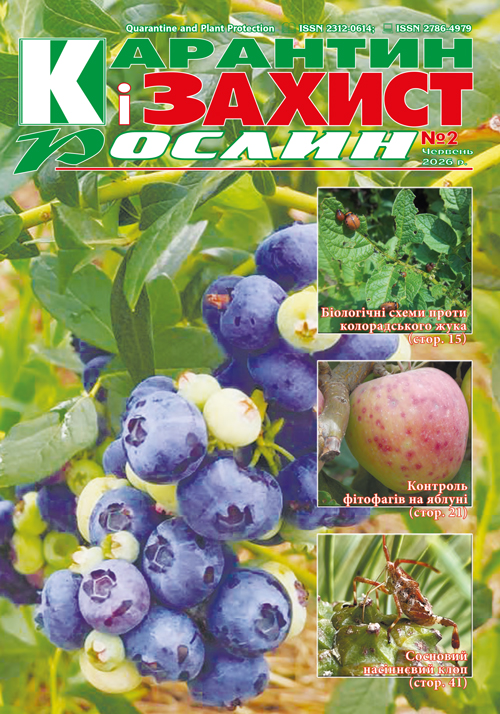
Efficiency of biological control for protecting potatoes against the Colorado potato beetle in the Western Forest-Steppe region of Ukraine
DOI:
https://doi.org/10.36495/2312-0614.2026.2.15-20Keywords:
potatoes, biological agents, harmful organisms, technical efficiency, saved yieldAbstract
Goal. To investigate the efficiency of biological control schemes based on biological preparations from ITI ‘Biotechnika’ against the Colorado potato beetle on potatoes in the Western Forest-Steppe of Ukraine.
Methods. Laboratory (pest identification) and field (analysis of growth parameters) studies. Six control schemes were investigated.
Results. Treatments 2 and 6 showed the best results against the Colorado potato beetle. Scheme 2: first treatment — Bitoxibacillin BT, SC (cells of the bacterium Bacillus thuringiensis var. thuringiensis, exospores, endospores, titre 2 × 10⁹ CFU/cm³), 3.0 l/ ha, second treatment — Metarhizine BT, SC (cells of the fungus Metarhizium anisopliae, titre 2.0 × 10⁹ CFU/cm³), 3.0 l/ ha, third treatment — Beauverin BT, SC (cells of the fungus Beauveria bassiana, titer 3.0 × 10⁹ CFU/cm³), 10.0 l/ha, fourth treatment — Actofit BT (cells of the fungus Streptomyces avermitilis, titer 1.0 × 10⁹ — 2.0 × 10⁹ CFU/cm³), 3.0 l/ ha). Scheme 6: first treatment — Bitoxibacillin BT, SC, 3.0 l/ha, second treatment — Boverin BT, SC, 10.0 l/ ha, third treatment — Actofit BT, SC, 3.0 l/ ha, fourth treatment — Metarizin BT, SC, 3.0 l/ha. The efficacy of scheme 2 was 70.1%, and that of scheme 6 was 71.7%. Biological protection schemes 2, 4 and 6 had a positive effect on structural yield indicators: the average tuber weight and the quantity of marketable and seed potatoes increased. The highest yield was obtained with biological protection scheme 6.
Conclusions. The use of biological insecticides helped to maintain potato yields by an average of 10.2—37.9% compared with untreated plots. The application of combinations of BT biological insecticides during the growing season helped to control the Colorado potato beetle and preserve the yield. The best protection was provided by a bioinsecticide treatment regime comprising four consecutive applications: the first — Bitoxibacillin BT, SC, 3.0 l/ha, the second — Boverin BT, SC, 10.0 l/ha, the third — Actofit BT, SC, 3.0 l/ha, the fourth — Metarizin BT, SC, 3.0 l/ha.
References
1. Food and Agricultural Organization Corporate Statistical Database (FAOSTAT). (2019). Food and Agriculture Organization of the United Nations Statistics Division. Rome: FAO. https://faostat3.fao.org/home/e
2. Bomok S., Taktaiev B., Pikovskyi M., Marieva O. (2020). Biokhimichni zminy v urazhenykh bulʹbakh kartopli. [Biochemical changes in affected potato tubers]. Protection and Quarantine of Plants, 1, 9-11. doi:10.36495/2312-0614.2020.01.9-12 (in Ukrainian).
3. Boroday V.V., Parfenyuk A.I. (2019). Rehulyatsiya fitopatohennoho fonu za diyi biopreparativ v ahrotsenozakh kartopli ta v umovakh yiyi zberihannya. [Regulation of phytopathogenic background under the action of biological preparations in potato agrocenoses and under its storage conditions]. Visnyk ahrarnoyi nauky. [Bulletin of Agrarian Science], (10), 37-42. https://doi.org/20.31073/agrovisnyk2019011-06 (in Ukrainian).
4. Food and Agricultural Organization Corporate Statistical Database (FAOSTAT). (2020). https://www.fao.org/faostat/en/#data/QCL
5. Artyukh T., Bezsmertna O., Melnyk D. (2022). Problemy ta perspektyvy rozvytku rynku kartopli v Ukrayini z vrakhuvannyam zonalʹnoyi spetsializatsiyi haluzi. Ekonomika ta suspilʹstvo. [Problems and prospects of potato market development in Ukraine]. Economy and Society, 39. https://doi.org/10.32782/2524-0072/2022-39-54 (in Ukrainian).
6. Birch P.R.J., Bryan G., Fenton B., Gilroy E.M., Hein I., Jones J.T., et al. (2012). Crops that feed the world 8: Potato: are the trends of increased global production sustainable? Food Sec., 4, 477-508. https://doi.org/10.1007/s12571-012-0220-1
7. Kalenska S.M., Knap N.V. (2012). Stan ta perspektyvy vyrobnytstva kartopli v sviti ta v Ukrayini. [State and prospects of potato production in the world and in Ukraine]. Zbirnyk naukovykh pratsʹ Vinnytsʹkoho natsionalʹnoho ahrarnoho universytetu. [Collection of scientific papers of Vinnytsia National Agrarian University], 4(63), 41-48. (in Ukrainian).
8. Eid M.A.M., Abdel-Salam A.A., Salem H.M., Mahrous S.E., Seleiman M.F., Alsadon A.A., Solieman T.H.I., Ibrahim A.A. (2020). Interaction Effects of Nitrogen Source and Irrigation Regime on Tuber Quality, Yield, and Water Use Efficiency of Solanum tuberosum L. Plant, 9(1), 110. https://doi.org/10.3390/plants9010110
9. Vashyshyn O.A. (2015). Poshkodzhennya sortiv kartopli drotyanykamy. [Damage to potato varieties by wireworms]. Peredhirne ta hirsʹke zemlerobstvo i tvarynnytstvo. [Foothill and mountain agriculture and animal husbandry], 57, 19-23. (in Ukrainian).
10. Zhuikov O.G. (2022). Biolohichnіy metod zakhystu roslyn u suchasnomu orhanichnomu zemlerobstvi Ukrayiny: istorychni aspekty, tendentsiyi, perspektyvy. [Biological method of plant protection in modern organic farming of Ukraine: historical aspects, trends, prospects.]. Ahranni innovatsiyi. [Agrarian innovations], (12), 23-27. DOI: https://doi.org/10.32848/agrar.innov.2022.12.4 (in Ukrainian).
11. Pisarenko V.M., Kovalenko N.P., Pospielova G.D., Pischalenko M.A., Nechyporenko N.I., Sherstiuk O.L. (2022). Suchasna stratehiya intehrovanoho zakhystu roslyn. [Modern strategy of integrated plant protection]. Scientific Progress & Innovation, (4), 104-111. https://doi.org/10.31210/visnyk2020.04.12 (in Ukrainian).
12. Fedorenko V.P. (Ed.). (2012). Stratehiia i taktyka zakhystu roslyn. [Strategy and tactics of plant protection]. T. 1. Kyiv: Alfa-steviia. 500 s. (in Ukrainian).
13. Matviichuk N.H., Matviichuk B.V., Kovalov V.B. (2021). Biolohizatsiia vyroshchuvannia kartopli v korotkorotatsiinii sivozmini Polissia. [Biologization of potato cultivation in short-rotation crop rotation of Polissya]. S. 312-320. URL: http://eprints.zu.edu.ua/34452/1/Матвійчук.pdf (in Ukrainian).
14. Chabaniuk Ya.V., Sherstobaieva O.V., Tkach Ye.D. (2013). Vyznachennia biolohichnoi efektyvnosti pestytsydiv i ahrokhimikativ. Metodychni vkazivky. [Determination of biological effectiveness of pesticides and agrochemicals. Methodological guidelines]. Kyiv, 36 s. (in Ukrainian).
15. Trybel S.O. (Ed). (2001). Metodyka vyprobuvannia i zastosuvannia pestytsydiv. [Testing technique and pesticide usage]. Kyiv: Svit. 448 p. (in Ukrainian).
16. Bondarchuk A.A., Koltunov V.A., Oliinyk T.M. ta in. (Bondarchuk A.A., Koltunov V.A. Eds.) (2019). Kartopliarstvo: Metodyka doslidnoi spravy. [Potato Growing: Research Methodology]. Vinnytsia: TOV «Tvory», 652 s. (in Ukrainian).
17. Solomiychuk M.P., Pikovskyi M.Y. (2022). Efektyvnist zastosuvannia biolohichnykh preparativ BT pry zakhysti kartopli vid shkidlyvykh orhanizmiv u Zakhidnomu Lisostepu Ukrayiny. [The effectiveness of the use of BT biological preparations in the protection of potatoes from harmful organisms in the Western Forest Steppe of Ukraine]. Fitosanitarna bezpeka. [Phytosanitary safety], (68), 168-181. https://doi.org/10.36495/1606-9773.2022.68.168-181 (in Ukrainian).
Downloads
Published
How to Cite
Issue
Section
License
Copyright (c) 2026 M.P. Solomiychuk, M.Y. Pikovskyi, A.T. Gavriluck, V.H. Semenchuk

This work is licensed under a Creative Commons Attribution 4.0 International License.